
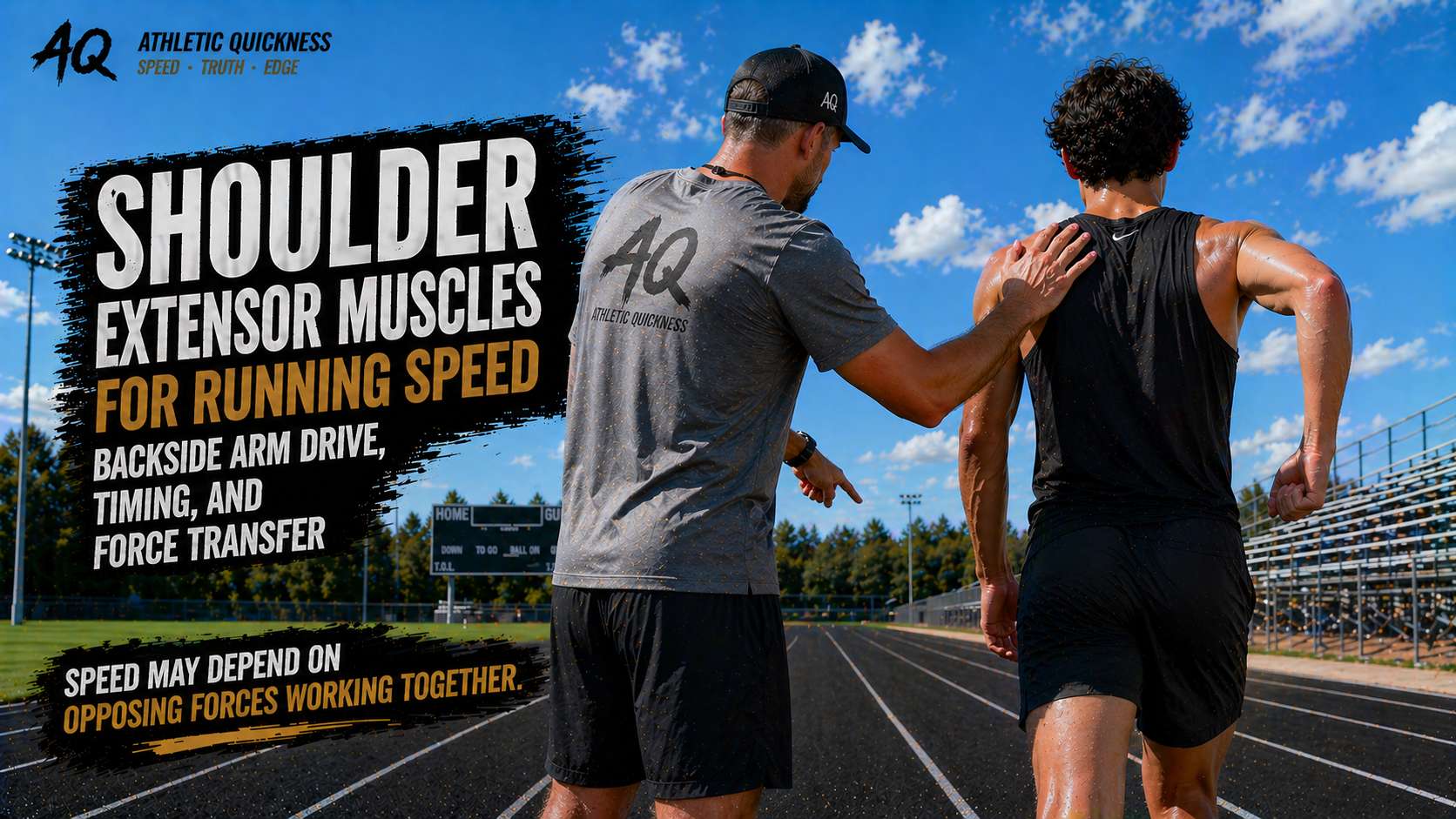
Home » Running Muscles for Speed » Shoulder Extensor Muscles for Running Speed: The Other Half of Arm Drive
🧠 Introduction
Most athletes pay attention—if they think about arm drive at all—
to the forward arm swing.
👉 drive the elbow
👉 pump the arms
👉 move faster
And that seems logical at first.
💥 But what if the backside arm action contributes just as much to running speed?
Or in some situations…
even helps organize what happens in the frontside of the stride?
That changes the conversation.
⚠️ The Half-Arm-Drive Problem
Many athletes think arm drive is mostly about what happens forward.
The front-side action gets attention.
But arm motion has two directions.
Forward (shoulder flexors)—
and back (shoulder extensors).
👉 And many athletes under-appreciate the backside half of the system.
🔑 Why Shoulder Extensors May Matter More Than You Think
As the arm drives backward,
shoulder extensors contribute to that action.
But this may be about more than “pulling the arm back.”
⚡ Backside arm drive may help support timing, rhythm, and force transfer across the stride.
That is much more than arm motion.
💥 What If Backside Arm Drive Helps Shape Frontside Speed?
Most athletes think the rearward arm swing follows the stride.
What if the opposite may also be true?
💥 What if backside arm action helps support what the lower body can express?
That’s a different model—
and an important one.
🔄 Running May Depend On Opposing Forces Working Together
This may be the hidden mechanism.
Speed may not simply come from isolated limbs producing force.
It may emerge from opposing actions coordinating force.
Push and counterbalance.
Forward arm drive and backside arm drive.
Transfer and timing.
⚡ Backside arm drive may help organize that system.
That matters.
🧩 Why Arm Drive May Be More Than Rhythm
Many athletes treat arm action as a metronome.
Helpful—
but secondary.
👉 But what if it also helps contribute to force transfer across the system?
💥 That elevates its role dramatically.
And shoulder extensors may sit in that conversation.
🚀 What This Means For You
Train backside arm drive as more than a mechanical cue.
👉 Train it as part of how the system coordinates opposing forces.
That means improving:
• rearward arm drive
• rhythm support
• rotational timing
• force transfer
👉 Not just faster—but more connected to the rest of the running speed system.
⚡ Efficient speed may depend on how opposing actions work together—not just individual movement.
➡️ How to Run Faster: The Complete Guide to Improving Speed Step by Step
🧭 You Are Here (Within The AQ Speed Training System)
You are currently exploring:
👉 SHOULDER EXTENSOR MUSCLES FOR RUNNING SPEED: THE OTHER HALF OF ARM DRIVE: why backside arm action helps support timing, torso rotation, and whole-body coordination during running.
🌐 See How This Fits Into The Complete AQ Speed Training System
👉 Discover how the shoulder extensors fit alongside the other major muscle groups involved in running speed.
➡️ RUNNING MUSCLES FOR SPEED: What Actually Matters (And What Doesn’t)
🪜 Continue Deeper Into Running Muscles for Speed
Learn how the shoulder flexors help support forward arm drive, torso rotation, and whole-body coordination during running.
➡️ Shoulder Flexor Muscles for Running Speed: Arm Drive, Rotation, and Coordination
Learn how the spine rotator muscles connect upper- and lower-body movement through coordinated torso rotation and force transfer.
➡️ Spine Rotator Muscles for Running Speed: How Rotation Connects Your Entire System
🚀 Ready to Run Faster?
👉 When you’re ready to apply these principles to improve your running speed:
➡️ Run Faster With Isometric Training!
❓ Frequently Asked Questions
Do shoulder extensors affect running speed?
👉 Potentially—especially through backside arm drive and coordination.
Does rearward arm drive matter in sprinting?
💥 It may matter more than many athletes realize.
Is arm drive only about the forward swing?
❌ Not necessarily.
Arm action may be a two-sided system.
Can backside arm mechanics affect leg speed?
⚡ They may help influence what the system can express.