
Home » Running Mechanics Explained » Why Running Relaxed May Be a Result of Better Mechanics
🧠 Introduction
Runners hear this advice all the time:
👉 relax
👉 stay loose
👉 stop tightening up
👉 don’t force it
But what does that actually mean?
Most of the time:
👉 almost nothing gets explained.
Athletic Quickness (AQ) views this very differently.
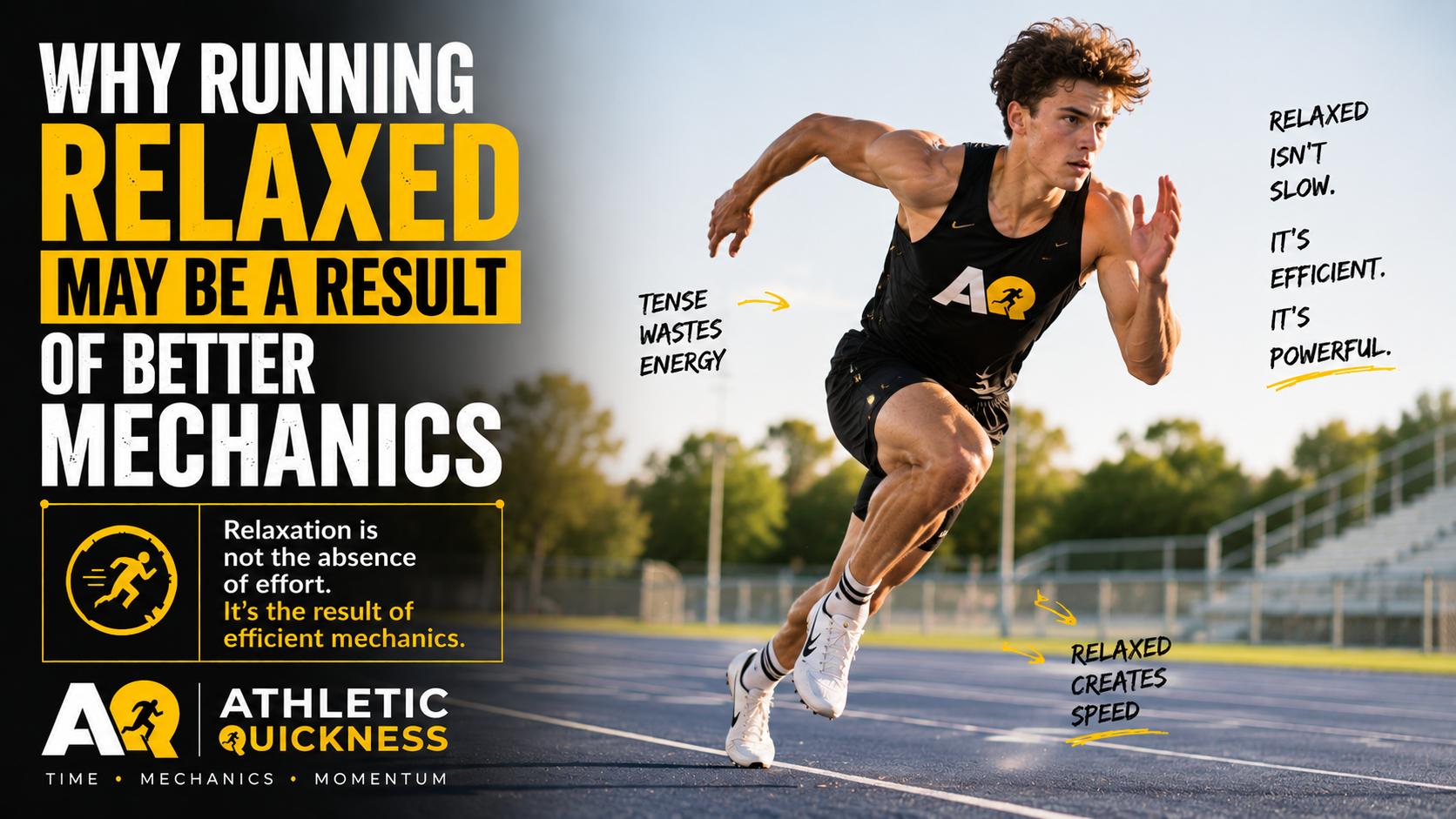
💥 Relaxed sprinting is often not something you FORCE.
It is often something better mechanics CREATE.
That changes the conversation completely.
Because smoother sprinting often emerges when:
• timing between steps improves
• whole-body push support improves
• swing-leg aggression helps stabilize aggressive pushing-leg expression
• force transfer becomes cleaner
• simultaneous force convergence improves
👉 Suddenly sprinting may feel:
- lighter
- smoother
- less strained
- more fluid
That is one of the biggest AQ distinctions.
💥 AQ uses “sprint system” to describe how the entire body — especially the swing leg, arms, and torso — supports and balances aggressive pushing-leg expression during high-speed running.
⚡ Why “Relax” Is Often Misunderstood
Many athletes hear “relax” and think:
• use less effort
• stop attacking
• back off
• run easier
But AQ says something very different.
💥 Relaxed sprinting does NOT mean passive sprinting.
It means:
💥 the sprint system is supporting aggressive movement more cleanly.
Huge difference.
Because elite sprinting is not:
❌ soft
❌ casual
❌ low effort
It is:
💥 aggressive force expression organized efficiently across the body.
That is a very different interpretation of “relaxed.”
🔄 Why Faster Sprinting Often Feels Lighter
This is one of the strongest athlete experiences AQ explains.
Because many athletes report that when their speed increases:
• sprinting feels smoother
• turnover feels cleaner
• rhythm feels easier
• speed feels less forced
• movement feels lighter
👉 Interesting.
Because many athletes assume:
❌ faster sprinting should feel harder and heavier.
But AQ explains why that often is not what athletes experience.
When simultaneous force convergence improves (between the arms, torso, swing leg, and pushing leg):
• timing sharpens
• force transfers cleaner
• support continuity strengthens
• interruptions decrease
• aggressive pushing-leg expression stabilizes better
💥 The sprint system stops fighting itself internally.
That changes how sprinting FEELS.
Not because force disappeared.
👉 Because force became better organized.
That is a massive distinction.
⚡ Why Tension Is Sometimes A System Warning
This is another important AQ distinction.
Sometimes excess sprint tension is not:
❌ the original problem.
It is:
💥 the body compensating for instability inside the sprint system.
That is VERY different.
Because when support relationships weaken:
• timing may drift
• force transfer may weaken
• the swing side may fall behind
• torso organization may destabilize
• aggressive pushing-leg expression may lose balance
👉 The body responds by tightening and protecting itself.
Interesting.
Because tension may sometimes be:
💥 a self-regulation response.
Not merely a bad habit.
🚨 Why The Body Self-Regulates Speed
This connects directly into one of AQ’s deepest ideas.
Because the body does not simply ask:
👉 “Can more force be produced?”
It also asks:
• can the sprint system support this?
• can aggressive pushing-leg expression stay balanced?
• can timing between steps remain organized?
• can the swing side keep up?
• can force transfer remain uninterrupted?
👉 If those support relationships weaken…
💥 the body self-regulates force expression, downward, to preserve balance across the sprint system.
That is HUGE.
This is one reason athletes often feel:
• stuck
• capped
• unable to “open up”
• powerful but not fast
• tight at higher speeds
Not because effort is missing.
👉 Because the sprint system is protecting balance.
That changes the interpretation of sprinting completely.
⚡ Why Better Mechanics Can Feel Effortless
This is where many athletes experience breakthroughs.
Mark Parson once described his sprinting this way after only a short period of hip-flexor-focused work:
“When I used to run, I always felt like I had to strain to run… now it’s effortless.”
That is a remarkable observation.
Because “effortless” does NOT mean:
❌ weak
❌ passive
❌ soft
It often means:
💥 the sprint system is supporting aggressive movement more effectively.
Huge difference.
Because when:
• swing-leg aggression improves
• timing between steps sharpens
• rotational support from the arms improves
• torso organization stabilizes
• force continuity strengthens
👉 the sprint system may suddenly support higher-speed movement more naturally.
That changes how sprinting FEELS.
Not because less is happening.
💥 Because more is working together simultaneously.
That is VERY AQ.
🔥 Why Relaxed Sprinting Is Often Misunderstood
AQ views relaxed sprinting as:
💥 aggressive movement with reduced internal interference.
That is VERY different from:
❌ “trying less.”
Because relaxed sprinting often still includes:
• violent swing-leg action
• aggressive pushing-leg expression
• strong rotational arm support
• powerful force exchange
• rapid system cycling
👉 The difference is:
💥 the sprint system is organizing those actions more cleanly.
That changes everything.
🛠️ What This Means For Speed Training
👉 speed training is more than:
• trying harder
• forcing relaxation
• sprinting aggressively alone
• quick-feet drills
• isolated force production
Because athletes also need to improve:
• whole-body push support
• swing-leg aggression
• timing between steps
• rotational support from the arms
• uninterrupted force transfer
• simultaneous force convergence
• strength balance across the sprint system
💥 Everything must support everything else continuously.
👉 Everything.
Because sprinting is not:
❌ isolated effort
It is:
💥 synchronized aggressive force organization across the body.
That is one of the deepest AQ distinctions.
🚀 What This Means For You
Most athletes think relaxed sprinting comes from:
👉 trying to relax.
But AQ shows something much deeper is happening.
💥 Relaxed sprinting is often the RESULT of stronger sprint-system support and cleaner force organization.
That changes how sprinting should be understood.
👉 And how speed should be trained.
Because smoother sprinting is not simply forced.
It is earned through:
• stronger whole-body support
• swing-leg aggression
• rotational support from the arms
• cleaner timing between steps
• uninterrupted force transfer
• simultaneous force convergence
• balanced aggressive pushing-leg expression
💥 That is a very different interpretation of running speed.
🧭 Go Deeper
👉 These articles connect directly into the larger AQ sprint framework:
➡️ Simultaneous Force Convergence: The Real Source of Running Speed
➡️ Pushing Leg Force vs. Whole-Body Push for Running Speed
➡️ Why Faster Turnover Doesn’t Always Make You Faster
👉 Together, these articles explain:
• sprint-system support
• timing between steps
• force continuity
• self-regulation
• whole-body push support
🎯 Start Here
👉 Want to see how AQ applies these ideas into actual speed training?
💥 Start here:
➡️ Run Faster With Isometric Training
👉 This is where the AQ framework connects:
• sprint mechanics
• resistance-band isometrics
• whole-body push support
• aggressive swing development
• system balance
• uninterrupted sprint cycling
❓ Frequently Asked Questions
Does relaxed running mean using less effort?
❌ Not necessarily.
👉 AQ views relaxed sprinting as aggressive movement supported more cleanly across the sprint system.
Why does faster sprinting sometimes feel lighter?
👉 Because stronger sprint-system support improves timing, force transfer, and simultaneous force convergence.
Why do elite sprinters often look effortless?
👉 AQ suggests elite sprinting often reflects cleaner force organization and reduced internal interference.
Can tension hurt sprint speed?
👉 Excess tension may sometimes reflect the body compensating for instability or weak support relationships inside the sprint system.
What helps sprinting feel smoother?
👉 Stronger swing-leg aggression, timing between steps, rotational arm support, and balanced sprint-system support all help improve force continuity and sprint flow.