
Home » Running Phases Explained » RUNNING PHASES EXPLAINED: How Your Legs Move When You Run
🚀 Introduction
Most athletes think running is just… running.
But what if your speed isn’t limited by effort—
but by what your legs are actually doing during each phase? 🤔
When you break sprinting down, something interesting happens:
It becomes simpler.
Not more complicated.
Instead of dozens of cues, drills, and corrections, everything mostly comes back to two primary roles:
- Push (Drive) Phase
- Swing Phase
Understand these—and you start to see speed differently.
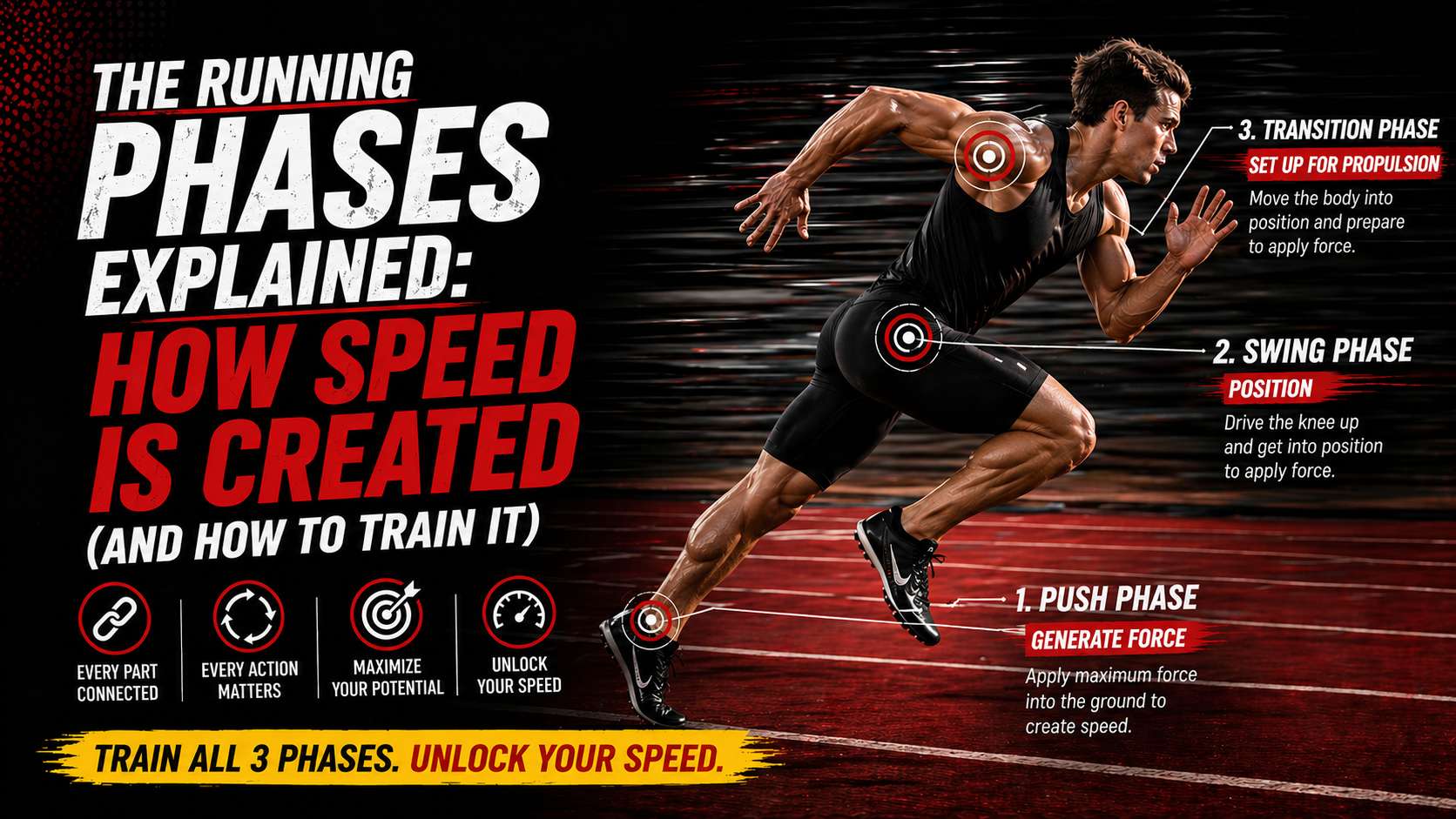
⚙️ The Two Phases That Actually Matter
At its core, running is a repeating cycle of two primary roles:
🔵 1. Push (Drive) Phase
Your foot is on the ground.
This is where you:
- Apply force into the ground
- Create propulsion
- Transfer energy through your body
👉 This phase determines how much force you produce.
🟡 2. Swing Phase
Your foot is off the ground.
This is where you:
- Recover the leg
- Reposition for the next step
- Prepare for the next push
👉 This phase determines how fast you can cycle your legs.
⚡ Simple Truth
Speed is not just about pushing harder…
It’s about how well these two phases work together.
🔄 What About the Transition Phase Between Swing and Push?
You may have heard of a third phase:
👉 the transition phase
So where does it fit?
After the leg swings forward…
👉 it must come back down
👉 return underneath the body
👉 and move into position for the next push
That transition is what we’re referring to as the transition phase.
👉 In simple terms:
- The swing phase brings the leg forward
- The transition phase helps bring the body-leg system into position for force
💥 But here’s the important part:
👉 This is not a separate system
👉 It is the transition between the end of the swing phase and the beginning of the push phase
👉 This doesn’t mean you are actively pulling yourself forward.
👉 It means your body is being brought back into position so force can be applied.
👉 This may not get as much attention as pushing or swinging—
👉 but it may be another overlooked opportunity to improve speed.
That’s why, in this model:
- We keep things simple with Push + Swing
- But understand the transition phase as what prepares the next push
👉 If you want a deeper breakdown of how this phase affects timing and efficiency:
➡️ Transition Phase of Running: An Often Overlooked Opportunity for Speed
❌ Why Most Athletes Misunderstand Running Phases
A lot of traditional teaching focuses heavily on:
- Stride length
- Stride frequency
- Foot strike
- Arm action
But these are outcomes, not root causes. ⚠️
If your:
- Push phase is inefficient → you lose force
- Swing phase is slow or mistimed → you lose rhythm
And if either one is off…
Your speed drops—even if everything “looks” correct.
💥 Push Phase: Where Speed Begins
The push phase is where speed is created.
But here’s what most athletes miss:
It’s not just about pushing hard…
It’s about how quickly and effectively you can apply force. ⚡
Key ideas:
- Force must be applied fast, not just strong
- Positioning determines how much force transfers
- Stability controls how much force is lost
If this phase is off, you’ll often see:
- Overstriding
- Collapsing posture
- Wasted energy into the ground
👉 To go deeper into why many athletes overemphasize this phase:
➡️ Push (Drive) Phase of Running: Why Most Athletes Overtrain It
👉 To understand why strength alone doesn’t equal speed:
➡️ Why Traditional Training Can Make You Stronger—But Not Always Faster
👉 To see how muscle type directly impacts speed:
➡️ 3 Types of Muscle Tissue and Why Only One Matters for Speed
🔄 Swing Phase: Where Speed Is Maintained
The swing phase doesn’t create force—
But it controls everything that happens next.
Think of it as the reset system of running. 🔁
Key roles:
- Rapid leg recovery
- Efficient repositioning
- Timing the next ground contact
If the swing phase is too slow or inefficient:
- Ground contact gets delayed
- Rhythm breaks down
- Speed stalls
👉 To go deeper into the role of hip flexors in this phase:
➡️ Swing Phase of Running: Why Hip Flexors Play a Major Role in Speed
🧠 The Real Secret: It’s Not One or the Other
Most athletes try to fix one phase in isolation:
- “Push harder”
- “Move your legs faster”
But running doesn’t work like that.
Each phase directly affects the other:
- A better push phase sets up a better swing
- A better transition phase allows the push to actually happen
- A faster swing phase improves the next push
👉 This is where running becomes a system, not just a sequence.
👉 To understand the full system behind this interaction:
➡️ Running Mechanics Explained: The System Behind Speed
🔍 A Better Way to Think About Speed
Instead of asking:
“How do I run faster?”
Try asking:
- Is my push phase producing force efficiently?
- Is my swing phase resetting quickly enough?
- Am I getting into position before I try to push?
Because speed isn’t just effort.
👉 It’s coordination. 🎯
🏁 What This Means for Training
When you understand running phases correctly…
You stop chasing symptoms.
And start improving function.
That leads to:
- More efficient movement
- Better timing
- Faster results ⚡
👉 Without needing more complicated training.
❓ FAQ: Running Phases Explained
What are the main phases of running?
The primary phases are the push (drive) phase and the swing phase, with the transition phase preparing the body for the next push.
What is the transition phase in running?
It’s the phase where the leg and body move back into position so the next push can occur.
When does the push phase actually begin?
The push phase begins when the body is in position to apply force—typically when the hip moves toward a neutral position.
Why do most athletes struggle with running phases?
Because they focus on surface-level mechanics instead of understanding how each phase actually functions.
Can improving running phases increase speed quickly?
Yes. When all parts of the stride cycle work together efficiently, speed often improves faster than expected.
🧩 Conclusion
Running faster isn’t about doing more.
It’s about understanding what’s already happening—and improving it.
Push.
Swing.
Transition.
Repeat efficiently.
👉 But do it better. ⚡